
3D Printing Science logo3D PRINTING
SCIENCE.
All grades & subjects

High school / Texas TEKS

Chemistry

Atomic theory, atoms & ions

Classroom tools

12 products
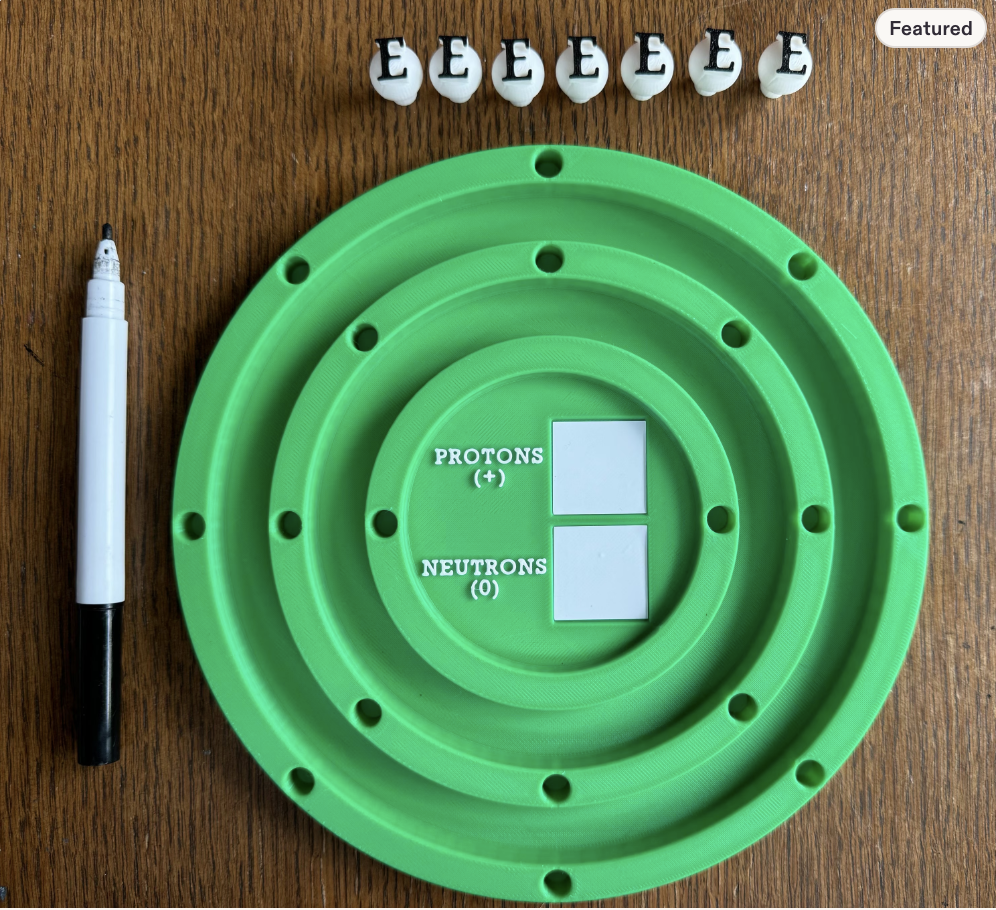
Green Interactive Bohr model with removable electrons and dry-erase nucleus

Bestseller

Interactive Bohr Model

TEKS Chem.6(A)Content connection

Represent the Bohr stage in the historical development of atomic theory; pair with other models to compare their limitations.

TEKS Chem.6(B)Content connection

Model subatomic particle locations and discuss atoms and ions. Contrast the fixed Bohr orbits with the modern electron-cloud model.

Students place electrons into orbital slots and build a physical picture of atomic structure.

Shop on Etsy

Chemistry

APE MAN

TEKS Chem.6(B)Content connection

Organize proton, neutron and electron counts for atoms and ions. Pair with discussion of particle masses, charges and locations.

A hands-on atomic structure tool with a dry-erase surface for working through science concepts.

Shop on Etsy

Physics

3D-Printed Heat Equation Manipulative

TEKS Chem.13(D)Content connection

Calculate heat, mass, temperature change and specific heat using their quantitative relationship.

TEKS Chem.13(B)Instructional support

Organize calculations alongside calorimetry investigations of heat transfer.

Organize heat calculations using Q = mcΔT.

Visit Etsy shop

Chemistry

APE MAN Atomic Structure Board — Wood

TEKS Chem.6(B)Content connection

Organize proton, neutron and electron counts for atoms and ions. Pair with discussion of particle masses, charges and locations.

Organize atomic number, particle counts and mass number on the wood APE MAN board.

Visit Etsy shop

Chemistry

Period 1 Atomic Model

TEKS Chem.6(B)Content connection

Model atoms and ions and discuss subatomic particle locations. Contrast fixed-orbit models with the modern electron-cloud model.

TEKS Chem.6(E)Instructional support

Use the model alongside representative-element electron configurations and Lewis dots. Shell models do not replace orbital notation; transition elements are extension work.

A physical atomic model for the first period of the periodic table.

Visit Etsy shop

Chemistry

Period 2 Atomic Model

TEKS Chem.6(B)Content connection

Model atoms and ions and discuss subatomic particle locations. Contrast fixed-orbit models with the modern electron-cloud model.

TEKS Chem.6(E)Instructional support

Use the model alongside representative-element electron configurations and Lewis dots. Shell models do not replace orbital notation; transition elements are extension work.

A physical atomic model for second-period elements.

Visit Etsy shop

Chemistry

Period 3 Atomic Model

TEKS Chem.6(B)Content connection

Model atoms and ions and discuss subatomic particle locations. Contrast fixed-orbit models with the modern electron-cloud model.

TEKS Chem.6(E)Instructional support

Use the model alongside representative-element electron configurations and Lewis dots. Shell models do not replace orbital notation; transition elements are extension work.

A physical atomic model for third-period elements.

Visit Etsy shop

Chemistry

Period 4 Atomic Model

TEKS Chem.6(B)Content connection

Model atoms and ions and discuss subatomic particle locations. Contrast fixed-orbit models with the modern electron-cloud model.

TEKS Chem.6(E)Instructional support

Use the model alongside representative-element electron configurations and Lewis dots. Shell models do not replace orbital notation; transition elements are extension work.

A physical atomic model for fourth-period elements.

Visit Etsy shop

Chemistry

Advanced Electron Configuration Bohr Model

TEKS Chem.6(E)Instructional support

Practice electron configurations for representative elements. Orbital diagrams, Hund’s rule, Pauli exclusion and Aufbau are supporting methods or extensions, not separately named requirements; this is not an AP-specific alignment.

Explore electron configurations with Aufbau, Pauli exclusion and Hund’s rule.

Visit Etsy shop

Chemistry

Dry Erase AP Chemistry Orbital Diagram

TEKS Chem.6(E)Instructional support

Practice electron configurations for representative elements. Orbital diagrams, Hund’s rule, Pauli exclusion and Aufbau are supporting methods or extensions, not separately named requirements; this is not an AP-specific alignment.

Practice orbital notation and electron configurations on a dry-erase board.

Visit Etsy shop

Chemistry

Ideal Gas Law Practice Board

TEKS Chem.10(B)Content connection

Calculate relationships among volume, pressure, moles and temperature of an ideal gas.

Set up ideal gas law problems using PV = nRT.

Visit Etsy shop

Chemistry

Mole Map Science Learning Tool

TEKS Chem.8(A)Content connection

Convert between moles and grams using the mole concept.

TEKS Chem.8(B)Content connection

Calculate atom or molecule counts using Avogadro’s number.

TEKS Chem.9(C)Instructional support

Organize conversions alongside stoichiometric mass and gas-volume problems; balanced equations and percent yield require additional instruction.

Organize conversions between moles, mass and particles.

Visit Etsy shop

Current science TEKS, implemented in 2024–2025. Connections are lesson-specific, not a claim that a product covers an entire standard. Instructional support identifies a modeling or calculation practice, not a direct content match. Standard descriptions are paraphrased.

Official TEA science standards

More from the print shop

See the full collection on Etsy.

Visit the shop