
Physics
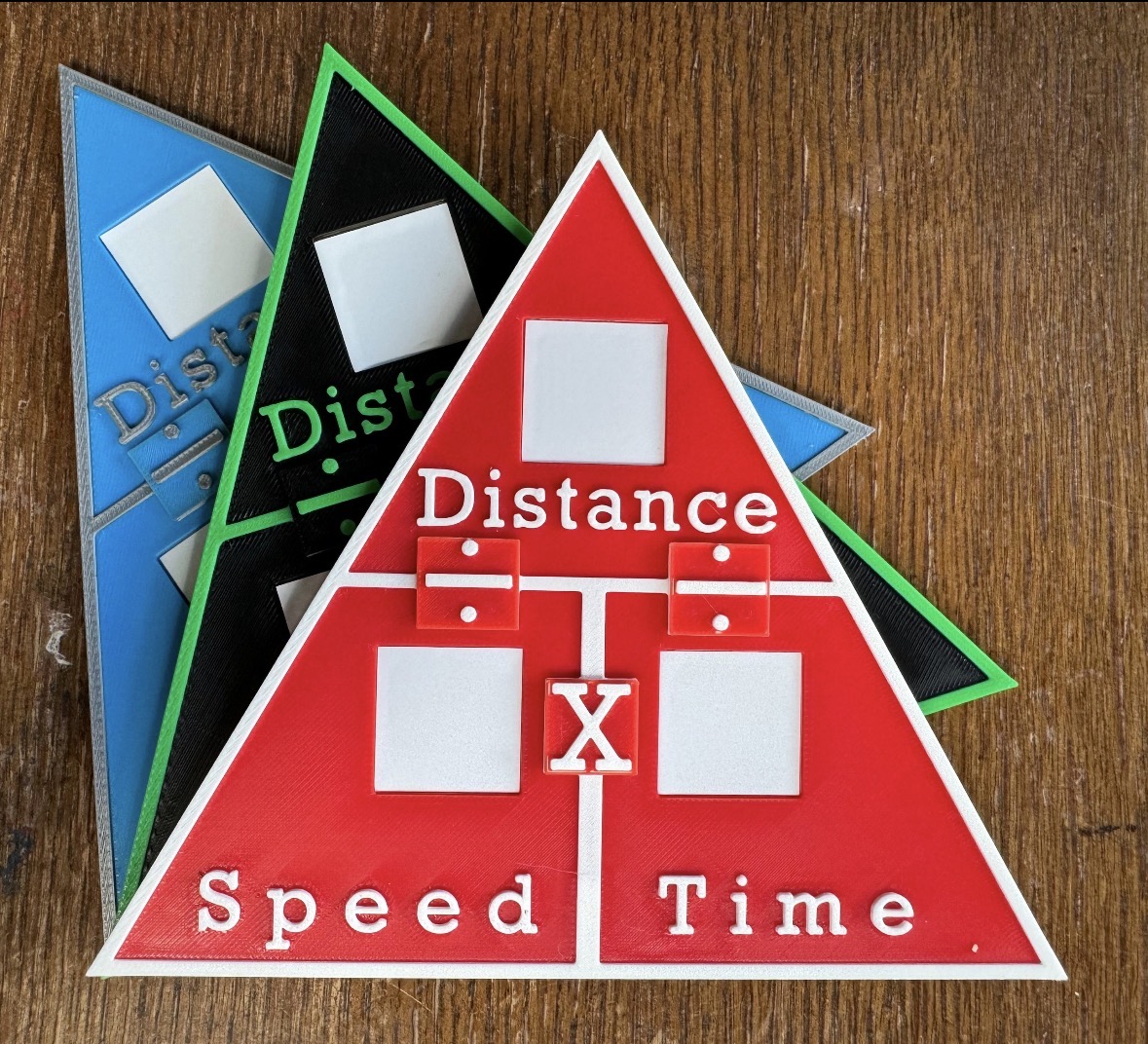
Speed Formula Triangle
Direct TEKS: 7.7(A) · Physics.5(C)
Supplemental TEKS: 6.2(C) · 8.2(C) · 7.7(C) · IPC.5(A)
Helps students calculate average speed, distance, and time and understand quantitative relationships describing an object’s motion.
Curriculum connections
Direct connections address a component of a standard, not the entire expectation. Supplemental connections support instruction or extend a lesson. Summaries are paraphrased from current official TEA standards.
Middle school
6th Grade Science
Use mathematical calculations to assess quantitative relationships in data.
Use measurements or graph data to practice quantitative calculations; this is scientific-practice support, not a content requirement for the formula.
8th Grade Science
Use mathematical calculations to assess quantitative relationships in data.
Use measured or graphed data for quantitative calculations; this is practice support, not a new average-speed content requirement.
7th Grade Science
Calculate average speed using distance and time measurements from investigations.
Calculate average speed from investigation measurements of distance and time.
Measure, record and interpret motion using distance-time graphs.
Use distance-time graph changes to interpret motion. Slope and speed calculations are supporting methods, not separately named requirements.
High school
Physics
Describe and analyze one-dimensional motion with distance, displacement, speed, velocity, reference frames and acceleration.
Calculate the speed component using distance and time; the other motion quantities need accompanying instruction.
Integrated Physics & Chemistry
Investigate, analyze and model position, velocity, acceleration and time using tables, graphs and mathematics.
Use calculations alongside motion graphs and investigations; the tool supports a portion of the full expectation.